English translations of three newspaper features about Rabbi Brandwein, with the Hebrew transcripts and original scans. The Davar article spans two pages.
The Rebbe of the Histadrut
Naftali Lavie · Haaretz · 20 September 1957 · p. 3
English translation from Hebrew
Download English translation (TXT)
The General Federation of Labour, the Histadrut, has sought to demonstrate its liberal attitude toward its religious members by establishing a religious affairs office and a Religious Worker faction. Yet this has not dispelled the impression among the religious public that the Histadrut represents the anti-religious element in the country. With more than half a million members, some 100,000 of them religious, it could no longer remain indifferent to the religious question. Its two religious bodies could not meet the demands of tens of thousands of religious members among the new immigrants: neither could rival the religious parties in their influence among believers. Hence the need for a department within the Histadrut to provide religious services.
Four well-known rabbis, several prominent religious party activists and one religious workers’ party negotiated with Executive Committee representatives on this basis. Three rabbis hold senior positions in HaPoel HaMizrachi, and one of them serves in the army. All three are active party men, and for that very reason the talks came to nothing. The fourth never held a rabbinical post, though he had been ordained by three outstanding Torah scholars of the preceding generation: Chief Rabbi Abraham Isaac Kook, Rabbi Hayyim Yosef Sonnenfeld, chief rabbi of the Edah HaHaredit, and Rabbi Yaakov Moshe Harlap, of blessed memory. He earned his living doing building work in the streets of Jerusalem and taught the esoteric tradition to his pupils in his spare time. It was this strictly observant man, who had never been involved in the country's public affairs, whom the Executive Committee representatives chose to head the department.
Talks with Poalei Agudat Israel fail
The Histadrut emissaries’ approaches to HaPoel HaMizrachi leaders went no further. One of the men approached expressed willingness to accept the post on the terms under which the department has now been established. But the Histadrut representatives were not enthusiastic about this candidate, whose standing among religious people was uncertain. They were interested, however, in negotiating with Rabbi K. F. Tchorz, a member of the Chief Rabbinate in Tel Aviv and head of the HaPoel HaMizrachi rabbinical association. Talks were still at an early stage when the Executive Committee representative discovered “right-wing tendencies” in the candidate; negotiations ended before they had formally begun.
Very serious talks were held with Poalei Agudat Israel (PAI). Histadrut secretary Pinhas Lavon, Mapai secretary Dr. Giora Josephthal, Knesset member Yona Kese and other Histadrut and Mapai figures found common ground with PAI leaders, who were willing to take responsibility for the Federation's religious affairs. The agreement was conditional on PAI joining the General Federation. PAI leaders, who did not see themselves as competitors of the Histadrut or the ruling party, were prepared to work with their sister workers’ party within the Federation, provided the religious interests of individuals and of the community were safeguarded. The Histadrut negotiators also wanted an agreement: the entry of this workers’ party might strengthen Mapai’s majority. That gave the negotiators, all members of the majority party, a considerable interest in the proposed agreement. Pressure from leading Torah scholars on PAI leaders prevented it, however, and the Histadrut representatives concluded that further talks would serve no purpose.
Talks between HaPoel HaMizrachi and the Religious Worker
There is still no proof of which came first: did the Histadrut's approaches to HaPoel HaMizrachi prompt that movement to make contact with the Religious Worker, or was it the other way around? What is certain is that while Federation emissaries were talking to HaPoel HaMizrachi, National Religious Party leaders invited the Religious Worker faction to join their party. The talks lasted nearly six months. At one meeting of the Religious Worker secretariat, a HaPoel HaMizrachi representative proposed that its members join the National Religious Party as a group, with suitable representation in all party bodies. The Religious Worker's resentment at the Executive Committee for negotiating with other religious groups evidently drew it closer to HaPoel HaMizrachi, and agreement was quite near. HaPoel HaMizrachi activists did not expect a large increase in membership. Their aim was mainly demonstrative: an agreement would have given them a useful weapon against the Histadrut in the immigrant settlements as elections drew near.
The prospect appears to have hastened the Histadrut's preparations to establish the religious services department. During discussions of the 1957/58 budget the Executive Committee had voted in principle to allocate 100,000 Israeli pounds for the new department. This enabled its representatives to negotiate and conclude an agreement. Without involving the other factions represented on the Central Committee or consulting the Religious Worker faction, Mapai’s Executive Committee representatives approached a Torah scholar who had only just emerged from obscurity. After lengthy inquiries the candidate, the Stratyn Rebbe, Rabbi Yehuda Tzvi Brandwein, agreed to head the department without any salary. Religious Worker leaders promptly refused to participate on a non-party basis. Only after several meetings was a three-person leadership agreed upon: Rabbi Brandwein, the department head; A. Ehrlich for the Religious Worker; and S. Levi for the religious affairs office of the cultural department.
The other factions do not object
We asked representatives of the Histadrut’s minority factions where they stood. They had no objection to the establishment or composition of the department. Mapam representative B. Lin believes increased Histadrut activity in religious affairs will loosen new immigrants’ ties to the religious parties and lessen those parties’ influence. Representatives of Ahdut HaAvoda–Poalei Zion and the Zionist Worker agreed. The latter faction’s representative, Y. Shaari, stressed that the department’s work might indeed serve a particular party in its competition with HaPoel HaMizrachi, which works in these areas through the Ministry of Religious Affairs. The speakers were more reserved about the choice of the Rebbe himself. Some felt that a rebbe who represented the old Jewish community to a certain extent might be better suited to the post than a different kind of religious figure.
Poalei Agudat Israel, still outside the Federation, responded with restraint. “If it turns out that the Histadrut truly wishes to provide for the religious needs of its members, all the better,” its leaders say, adding that the strictly observant public would welcome this. Well-known rabbis in Jerusalem and Tel Aviv, including some noted for their uncompromising views, responded similarly.
HaPoel HaMizrachi leaders, by contrast, maintain that the Histadrut hopes to gain a political advantage by setting up the department under a rebbe.
The Rebbe promises “religion for its own sake”
For the first time in his life the Rebbe appeared this week before a different kind of “Hasidim”: the Histadrut Central Committee, veteran labour activists and members of the new department. The little-known rebbe, who to this day spends most of his time over his books, found himself in the Executive Committee building, surrounded by religious colleagues and secular sons of rabbis, Histadrut leaders who had brought him to this post. No programme has yet been presented, but one promise was made: “Religion for its own sake, not religion for the sake of a party or a party for the sake of religion.” How does he propose to achieve this? “Quite simply, through love of the Jewish people and without any coercion.” We asked about the budget. The department has been promised 180,000 pounds. He wishes to tour the country, the immigrant settlements, veteran workers’ neighbourhoods and kibbutzim, to talk to people and hear about their spiritual needs. Requests have already come in for 250 synagogues and about a hundred Torah classes.
We were unable to establish the Rebbe’s own outlook. He is 54, of the house of Stratyn, and was born in Safed. His modest apartment on the edge of Tel Aviv's Yemenite Quarter, his manners, his origins in the unassuming court of Stratyn and his working background all suggest that he belongs to the “working class.” On his return from a Hungarian yeshiva he took no sacred office. Instead he climbed the scaffolding of buildings he erected in Jerusalem’s Bukharan Quarter. Manual labour did not keep him from devotion to both esoteric and revealed Torah. Jerusalem’s leading rabbis ordained him, and the Stratyn Hasidim “crowned” him their rebbe. Since the end of the Second World War he has lived in Tel Aviv and barely made ends meet. Yet in agreeing to head the Histadrut department he stipulated expressly that he would take no salary. His second condition was that the Federation should fulfil its promises to the department in good faith.
We asked what rabbis and rebbes thought of the Histadrut’s new rebbe, whose realm stretches over half a million “Hasidim.” Most answered both yes and no. Interestingly, someone close to Neturei Karta welcomed the appointment, expressing hope that it might mark a change for the better in the Federation’s handling of religious matters.
The Rebbe himself is not disconcerted by the campaign of vilification that certain religious circles have begun against him.
Photograph caption
Rabbi Yehuda Tzvi Brandwein
Show Hebrew transcript
האדמו״ר של ההסתדרות
Hebrew transcript
Transcribed from the Hebrew scans. Consult the original scan to verify a quotation.
נסיונותיה של הסתדרות העובדים הכללית להוכיח את יחסה הליברלי לחבריה הדתיים, בהקימה מדור לעניני דת וסיעת „העובד הדתי”, לא הצליחו לטשטש את הרושם שנוצר בציבור הדתי, לפיו מיצגת ההסתדרות את הגורם האנטי־דתי בארץ. עתה, לאחר שריכזה למעלה מחצי מיליון חברים ובהם כ־100 אלף דתיים, לא יכלה להשאר באדישותה לבעיה הדתית. שני הגופים הדתיים הפעילים בתוכה לא יכלו לספק את דרישתם של רבבות החברים הדתיים מהעליה החדשה, משום שלא יכלו לשמש מתחרים למפלגות הדתיות בהשפעתן בקרב הצבור הדתי. סיבות אלה עוררו את הצורך להקים בהסתדרות מחלקה לסיפוק צרכי הדת.
ארבעה רבנים ידועים, מספר עסקנים בעלי עמדה במפלגות הדתיות ומפלגת פועלים דתיים אחת ניהלו שיחות על רקע זה עם נציגי הועד הפועל של ההסתדרות. שלושה מהרבנים תופסים עמדות חשובות בהסתדרות הפועל המזרחי ואחד מהם ממלא תפקיד בצבא. שלושתם אנשי מפלגה פעילים, ואילו מסיבה זו לא הוכתרו השיחות בהצלחה. הרביעי מעולם לא כיהן ברבנות אך סמכוהו שלושה מגדולי התורה של הדור הקודם: הרב הראשי ראי״ה קוק, הרב ח. ז. זוננפלד, הרב הראשי של העדה החרדית, והרב י. כ. חרל״פ זכרם לברכה. פרנסתו היתה על מלאכות בניה ברחובות ירושלים, ובשעות הפנאי הרביץ את תורת הנסתר לתלמידיו. באישיות חרדית זו, שלא היתה מעולם מעורבת בבעיות הצבור בארץ, בחרו נציגי הועד הפועל של ההסתדרות לעמוד בראש המחלקה לסיפוק צרכי הדת.
המו״מ עם פא״י נכשל
הגישושים שנעשו אצל עסקני הפועל המזרחי מצד שליחי ההסתדרות לא הביאו להמשך. אחד האישים בהסתדרות זו, עמו התנהלו שיחות אלה, הביע את רצונו לקבל עליו את התפקיד באותם התנאים שלפיהם הוקמה כעת המחלקה. אך אנשי ההסתדרות לא התלהבו ממועמד זה, שמעמדו בצבור הדתי מעורער. לעומת זאת גילו אנשי ההסתדרות ענין במו״מ עם הרב כ. פ. טכורש, חבר הרבנות הראשית בתל אביב וראש חבר רבני הפועל המזרחי. השיחות אתו עוד היו בשלב מוקדם כאשר נציג הועד הפועל גילה במועמד זה „נטיות ימניות” והמו״מ נסתיים לפני פתיחתו הרשמית.
שיחות רציניות מאד התנהלו עם אנשי פועלי אגודת ישראל. בדיונים אלה, בהם השתתפו מזכיר ההסתדרות מר פינחס לבון, מזכיר מפא״י ד״ר גיורא יוספטל, חבר הכנסת מר יונה כסה ואנשי ההסתדרות ומפא״י אחרים, נמצאה לשון משותפת עם ראשי פא״י, שהביעו את נכונותם לקבל לידיהם את הטיפול בעניני הדת של ההסתדרות. הסכם זה היה מלווה תנאי בדבר הצטרפות פועלי אגודת ישראל להסתדרות העובדים הכללית. אנשי פא״י, שאינם רואים עצמם כגורם מתחרה להסתדרות או למפלגה השלטת, היו נכונים לשתף פעולה עם מפלגת הפועלים האחות במסגרת ההסתדרות, על בסיס שיבטיח אי פגיעה בעניני הדת של הפרט והכלל בהסתדרות. נציגי ההסתדרות היו גם הם מעוניינים להגיע להסכם עם פא״י. הצטרפותה של מפלגת פועלים זו להסתדרות יכלה לתרום לחיזוק הרוב של מפא״י. בסיבה זו היה ענין רב למנהלי המו״מ מצד ההסתדרות, שנמנו כולם עם מפלגת הרוב, בהסכם המוצע עם פא״י. אולם לחץ שהפעילו גדולי התורה על ראשי פועלי אגודת ישראל מנע את ההסכם, ונציגי ההסתדרות הגיעו למסקנה שאין טעם להמשיך בשיחות אלה.
מו״מ בין הפועל המזרחי ל„העובד הדתי”
עדיין אין כל הוכחות מה קדם למה, אם גישושי ההסתדרות אצל עסקני הפועל המזרחי הביאו לפעולות־נגד מצד הפועל המזרחי שהקים מגע עם „העובד הדתי”, או ההיפך. אך עובדה היא כי באותו זמן, ששליחי ההסתדרות ניהלו שיחות עם אנשי הפועל המזרחי, פנו נציגי הנהלת המפלגה הדתית־לאומית לראשי „העובד הדתי” להצטרפותה של הסיעה ההסתדרותית למפלגה זו. קרוב לחצי שנה התנהלו שיחות אלה, ובאחת מישיבות המזכירות של „העובד הדתי” השתתף גם נציג הפועל המזרחי שהציע לחברי „העובד הדתי” לעבור בצורה קיבוצית למפלגה הדתית־לאומית תוך הבטחת ייצוגם המתאים בכל מוסדות של מפלגה זו. מסתבר כי התמרמרותם של אנשי „העובד הדתי” על המו״מ של הועה״פ עם גורמים דתיים שונים בדבר הקמת מחלקה לעניני דת בהסתדרות היתה רבה והסכם היה קרוב למדי. פעילי הפועל המזרחי לא ציפו להתגברות כמותית מהסכם זה. מגמתם היתה הפגנתית בעיקר. לוא הושג הסכם זה, היה משמש בידיהם כנשק יעיל במאבקם נגד ההסתדרות, שיגבר עתה בישובי העולים, עם התקרב מועד הבחירות.
נראה כי תוצאות אפשריות של הסכם כזה החישו את פעולתם של אנשי ההסתדרות לקראת הקמתה של המחלקה לסיפוק צרכי הדת. ההחלטה העקרונית שנתקבלה בועד הפועל בעת דיוניו על התקציב 1957/58, לפיה הוקצבו 100 אלף ל״י לפעולות המחלקה לסיפוק צרכי הדת שתקום, אפשרה לנציגי הועד הפועל לנהל המו״מ וסיומו. ללא שיתופן של הסיעות האחרות המיוצגות בועדה המרכזת של ההסתדרות וללא התייעצות בסיעת „העובד הדתי” באו נציגי מפא״י בועד הפועל של ההסתדרות במגע עם אישיות תורנית שהוצאה זה עתה מאלמוניותה. לאחר בירורים ממושכים הסכים המועמד, האדמו״ר מסטרטין, הרב יהודה צבי בראנדוויין, לקבל על עצמו את תפקיד ראש המחלקה ללא כל משכורת. אנשי „העובד הדתי” מיהרו וסירבו להשתתף במחלקה על בסיס בלתי מפלגתי. רק לאחר פגישות מספר הוסכם על הרכב הנהלת המחלקה: שלשה אנשים, והם הרב בראנדוויין, ראש המחלקה, מר א. ארליך מטעם „העובד הדתי”, ומר ס. לוי מטעם המדור לעניני דת שליד המחלקה לתרבות.
הסיעות האחרות אינן מתנגדות
פנינו לנציגי סיעות המיעוט בהסתדרות כדי לשמוע על עמדתם בענין זה, והתברר כי אין להם שום התנגדות להקמתה ולהרכבה של מחלקה זו. נציג מפ״ם מר ב. לין סבור כי פעילותה המוגברת של ההסתדרות בשטח הדת תמנע את זיקת העולים החדשים למפלגות הדתיות ותחליש את לחצן של מפלגות אלה בעניני דת. לדבריו של מר לין היו שותפים מסיעות „אחדות העבודה־פועלי ציון” ו„העובד הציוני”. נציג הסיעה האחרונה, מר י. שערי, הטעים כי פעולתה של מחלקה זו אמנם עלולה לשרת מפלגה מסוימת בהתחרות עם הפועל המזרחי, הפועל בשטחים אלה באמצעות משרד הדתות. אשר לעצם בחירתו של האדמו״ר לתפקיד ראש המחלקה הסתייגו הדוברים בתגובותיהם. אחדים מהם הביעו את דעתם כי אדמו״ר המייצג במידת מה את הישוב הישן עלול להתאים לתפקיד זה יותר מאשר אישיות דתית מסוג אחר.
פועלי אגודת ישראל, שנשארו בינתיים מחוץ להסתדרות, הגיבו בהתאפקות על הקמת המחלקה. „אם יתברר שההסתדרות רוצה באמת לספק צרכי דת לחבריה — אדרבא ואדרבא”, אומרים ראשי פא״י, המוסיפים כי הציבור החרדי יקדם זאת בברכה. תגובה דומה השמיעו רבנים מפורסמים בירושלים ובתל אביב, בהם הידועים בקיצוניותם.
לעומת תגובות אלה טוענים ראשי הפועל המזרחי כי עניני ההסתדרות בהקמת מחלקה זו, בראשותו של אדמו״ר, לרווחים פוליטיים.
האדמו״ר מבטיח: „דת לשם דת”
בפעם הראשונה בחייו הופיע השבוע האדמו״ר בפני צבורי „חסידים” מסוג שונה. היו אלה חברי הועדה המרכזת של ההסתדרות, עסקני פועלים ותיקים וחברי המחלקה החדשה. והרבי האלמוני, היושב עד היום מרבית שעות היום על ספריו, מצא עצמו בבנין הועד הפועל של ההסתדרות מוקף חברים דתיים ובני־רבנים חילוניים, מראשי ההסתדרות, שהעלוהו לתפקיד זה. שום תכנית פעולה טרם הוצגה, אך דבר אחד הובטח: „דת לשם דת ולא דת לשם מפלגה או מפלגה לשם דת”. כיצד הוא חושב לממש זאת? — שאלנו אותו. „פשוט למדי, על ידי אהבת ישראל וללא שום כפיה”, השיב. שאלנו בדבר תקציב. 180 אלף ל״י הובטח למחלקה. רצונו לסייר בארץ, בישובי עולים, בשיכוני ותיקים ובקיבוצים כדי לשוחח עם הצבור ולשמוע על צרכיו הרוחניים. עד כה נתקבלו פניות להקמת 250 בתי כנסת וכמאה שיעורים תורניים.
לא הצלחנו לעמוד על השקפתו העצמאית של האדמו״ר. בן ה־54, לבית סטרטין שנולד בצפת, דירתו הצנועה שעל גבול „כרם התימנים” בתל אביב, הליכותיו, מוצאו מחצר סטרטין העממית, ועברו הפועלי מעידים על השתייכותו ל„מעמד הפועלים”. כאשר חזר מישיבת הונגריה לא קיבל על עצמו משרה של משמש בקודש, אלא טיפס על פיגומי הבנינים שהקים בשכונת הבוכרים בירושלים. מלאכת כפיים לא מנעה ממנו התמסרות ללימודי הנסתר והנגלה, כך שגדולי הרבנים בירושלים סמכוהו לרבנות, וחסידי סטרטין „המליכוהו” לרבם. מאז סיום מלחמת העולם השניה יושב הוא בתל אביב ומתפרנס בדוחק, אך עם הסכמתו לנהל את המחלקה ההסתדרותית התנה במפורש שלא יקבל משכורת. התנאי השני היה כי ההסתדרות תמלא בכנות את הבטחותיה למחלקה.
ביקשנו לדעת על יחסם של הרבנים והאדמו״רים לאדמו״ר החדש של ההסתדרות, שממלכתו פרושה על חצי מיליון „חסידים”. רובם ענו לחיוב ולשלילה גם יחד. הענין הוא שאחד ממקורבי „נטורי קרתא” הביע את דעתו לחיוב, תוך הבעת תקוה למפנה ברכה של ההסתדרות בעניני דת.
הרבי עצמו אינו נבוך ממסע ההשמצה שחוגים דתיים מסוימים פתחו נגדו.
כיתובי תצלומים
הרב יהודה צבי בראנדוויין
The Workers’ Rabbi
Written and photographed by Shraga Har-Gil · Davar · 25 September 1959 · pp. 22–23
English translation from Hebrew
Download English translation (TXT)
A would-be convert came before Shammai and said: Convert me on condition that you teach me the whole Torah while I stand on one foot. Shammai pushed him away with the builder’s measuring rod in his hand. He came before Hillel, who converted him and said: “What is hateful to you, do not do to your fellow. That is the whole Torah; the rest is its explanation.” (Shabbat 31a)
At the edge of Tel Aviv’s Yemenite Quarter, a stone’s throw from busy Allenby Street and the bustling Allenby Cinema, lies a narrow, quiet street. It is Hillel the Elder Street. Number 10 is an old house that shows the marks of time. It has two storeys. From the upper one you can look in two directions: to the north, in the evening, you can see the end of the long queues for the cinema; toward the sea, elderly Yemenite women sit talking in their doorways, with dark-complexioned children beside them doing their lessons because it is too hot and cramped indoors.
A small white sign at the entrance reads: Rabbi Yehuda Brandwein.
Last week we went to see Rabbi Brandwein. Sitting before him in his whitewashed apartment with its worn furnishings, we proposed to interview him as we had interviewed dozens of people before. But before we could ask our first question, we realized that the rabbi was quite unconcerned about what we might write.
What matters most is how one person treats another
“Why ask me questions?” said the rabbi. “Among us Hasidim we don’t ask questions; we tell stories. I was in Ashkelon when a Jew came up to me and said: ‘I am not religious, but if they wake me in the middle of the night to do someone a kindness, I get up and do it.’ I told him: ‘When you say you are not religious, that is because you do not know. A Jew who gets up in the night to help his neighbour is practising the religion of Israel.’”
“As you know, there are two kinds of commandments: those between one person and another, and those between a person and God. The first take precedence. For one thing, they cannot become mere habit. On one occasion you help a poor man; on another you join a prayer quorum. To someone who practises them, the commandments give what he needs. With duties toward God it is different. They are very important, of course, but they can always turn into something done by rote. A man says his prayers day after day. If, God forbid, he no longer notices what he is saying, he certainly won’t act in accordance with his prayer. Look deeper and you will see that those who fulfil their duties toward their neighbours may be keeping more commandments than the self-appointed guardians of religion who concern themselves only with duties toward God.
“Let me tell you a story. When Reb Itche Leib Diskin came from Brisk to Jerusalem, he sought something spiritual that had survived the destruction of the Temple. He found the Western Wall, but even the Western Wall is only stones. Where was the spiritual thing? He searched and searched, until he said: ‘I have found it: the baseless hatred that destroyed the Temple.’ Satan has no small part in baseless hatred. He incites one Jew: ‘Take a bus on Shabbat. Go where observant Jews live and desecrate Shabbat in public.’ Then he whispers in another Jew’s ear: ‘Go out in the street and shout, “It’s Shabbat!”’ The two quarrel, and Satan sees his work done for him. That is baseless hatred. What is more, Satan will let you keep every commandment you like except one: loving the Jewish people, loving all Israel. So if we faithfully discharge our obligations to one another, we shall come to fulfil the other commandments too. But if we insist on forcing obligations toward God on people who are not ready for them, Heaven forbid, we shall be doing Satan’s work.
“When they came and told me, ‘You are to head the religious department of the Workers’ Federation,’ at first I couldn’t believe what I was hearing. Then I said: ‘By all means. I believe my prayers have been heard. I have always prayed that the Jews in the Land of Israel might return to their Maker.’ They said: ‘Name your salary for the post we are offering you.’ I said: ‘If I had money, I would help you. I don’t want your money.’ That was how I became head of the Histadrut’s religious services department. But I did not abandon my former occupations. I receive visitors in the afternoons, though people trouble me all day long. And it is good that they do: it gives me the chance to fulfil a great commandment. When budgets are allocated, I go to the Histadrut Executive Committee, sit as long as I sit and advise whom to give to first and whom last. I asked one thing: Let me do what I must, and don’t mix politics with religion. They allow me that. When Jews come to me, I don’t ask if they belong to Mapai or even whether they are religious. I can help them establish a synagogue; that is enough.
“As the sage said, Israel will be redeemed only when its people unite. I do not hold with religious parties. They have made religion a spade to dig with. I asked a rabbi on a moshav: ‘Do you have any influence on the people here?’ He replied: ‘How can I? I have eight children and receive eighty pounds a month. Every farm labourer earns more. Only rabbis who belong to the National Religious Party got a pay rise. All the others were supposed to starve. Why? Because the rule was: “Find yourself a rabbi [one of your own] and acquire [a membership card for] a friend [of HaPoel HaMizrachi].”’ The minister, Rabbi Yaakov Moshe Toledano, raised rabbis’ salaries so they could support themselves, without increasing his ministry’s budget. Religion is not politics. In everything we do we must seek what unites Israel, so that its people may be one.”
“Proletarian Hasidism”
The teachings of Rabbi Israel Baal Shem Tov have taken on and cast off different forms in the roughly two hundred years since the movement arose. At first it was a popular movement among ordinary people in the provinces of Poland, Podolia and White Russia. In time the teachings spread to Galicia and Moldavia. There the followers of the Baal Shem Tov’s disciples were joined by wealthy, influential members of the community. Courts arose around his disciples and their disciples, each cultivating its own path and method. In eastern Galicia two Hasidic courts developed: one in Chortkiv, home of a son of the rebbe of Ruzhin; the other in Stratyn, where the tzaddik Rabbi Yehuda Tzvi, founder of the Stratyn dynasties, lived. Chortkiv’s court was run in wealth and splendour. The rebbe’s residence resembled an aristocrat’s palace, and wealthy Jews flocked there. The court of Stratyn, by contrast, chose simplicity and attracted ordinary people and the poor.
They tell this story of Rabbi Yehuda Tzvi, traditionally said to have been the sixteenth generation of preachers and rabbis in his family. A Hasid once brought him wine in a gold-plated cup. The rebbe recited Kiddush over it, then noticed, as he tasted the wine, that the cup was gold. He summoned the Hasid: “Why waste your money on a gold cup instead of giving it to the poor?” The Hasid replied: “Rebbe, it isn’t gold, only gold-plated.” “Then you certainly did wrong,” said the rebbe. “It’s an illusion, a pretence, and nothing is more repugnant.” He poured the wine into a tin cup. The gilded cup he gave to a poor man to sell in the market and live on the proceeds.
The people of Stratyn used to say: “The poorer a man is than his neighbour, the more praiseworthy he is.” The Stratyn Rebbe regarded the prayer Nishmat Kol Hai (“The soul of every living thing”) as the most important of all, for it says: “You hear the cry of the poor; You heed the outcry of the needy and save them.” The Chortkiv Hasidim boasted that their rebbe ate from gold dishes; the Stratyn Hasidim proudly told how theirs ate from tin and wood. Aaron Marcus, a scholar of Hasidism, called Stratyn “proletarian Hasidism,” unaware how prophetic his words were. Decades later a rebbe of the house of Stratyn, named for the founder of the court, became the rabbi of Israel’s workers.
About two generations before the First World War both courts had to leave and seek new homes. Chortkiv’s court moved to Vienna, capital of Austria, where it maintained a splendid royal palace; the women of the court went about in gloves and finery. The Stratyn Hasidim went to the Land of Israel and settled in Safed, city of the Kabbalists. Reb Aryeh’le went to Safed; after his passing his son, Reb Avraham, of blessed memory, led the Stratyn Hasidim there. His grandson, Reb Tzvi Yehuda of the Brandwein family, son of Reb Avraham, is today the Stratyn Rebbe, responsible for religious services in the General Federation of Hebrew Workers in the Land of Israel.
Taking on the duty of work
Reb Yehuda Tzvi knew much suffering. During the World War, pressure from the Turkish authorities forced him to leave the country. He lived in Satmar, Hungary, where he subsisted on scant bread and water and studied in a yeshivah. Returning after the war, he settled in the Old City of Jerusalem and studied the esoteric tradition. There he met the Kabbalist Reb Shlomo Wessler and married his only daughter. She bore him twins and died young.
Widowed and left to provide for two orphans, the “man of sorrows,” as the people of the Old City called him, took up the duty of work. He went to a building site, watched and learned the trade. He began as a formwork carpenter and gradually became a subcontractor in that craft. Jerusalemites would see the broad-shouldered young scholar with his long sidelocks standing on the scaffolding, working in mortar and brick and humming Hasidic melodies. Toward evening the carpenter put on his black coat and went to the old study house of the Kabbalists, where he immersed himself in Gemara and Kabbalah. Sometimes, they say, Reb Yehuda Tzvi scarcely had time to wash the lime off his hands. Not wanting his pupils arriving for a lesson to see him in this state, he hid his hands in his coat pockets. Once his pupils even noticed nails sticking out through his coat and piercing holes in it. Apparently he had hurried so from work to the study house that he had forgotten to take off his carpenter’s belt.
Later, Reb Yehuda Leib Ashlag came from Warsaw to Jerusalem. A renowned Kabbalist, he had written commentaries on the Zohar. The two men became deeply attached. Reb Yehuda Tzvi said he was Reb Yehuda Leib’s pupil, while the elder Reb Yehuda Leib used to say he was the young rebbe’s pupil. Reb Yehuda Tzvi married Reb Yehuda Leib’s daughter. They had six daughters and a son, now fourteen, who studies at the Ponevezh Yeshivah in Bnei Brak.
During the Second World War, when work and building in Jerusalem came to a halt, Reb Yehuda Tzvi moved his household to Tel Aviv. He lived in an old house on Aharonson Street, in poverty and hardship. When he failed to pay his rent, the landlord evicted him, throwing him, his children and his belongings into the street. Reb Yehuda Tzvi accepted his suffering with love. Without a sound, he sat under the open sky for some two weeks, until passers-by discovered the rebbe lying outside and raised an outcry in the newspapers. This was how hundreds of Stratyn Hasidim learned what had happened. They bought him the modest apartment on Hillel the Elder Street, with its adjoining synagogue, where he lives to this day.
As Hillel the Elder said
Since then, Rabbi Yehuda Tzvi has earned a meagre living giving rulings on religious practice and has devoted his days and nights to Torah. He wrote a translation and commentary on the Zohar entitled Maalot HaSulam (“The Rungs of the Ladder”). Like his teacher, Reb Yehuda Leib, he omitted his own name as author from the front of the book, giving only the names of the donors who helped publish it. Since taking up his Histadrut duties he has written another Kabbalistic commentary, an Introduction to the Tikkunei Zohar. He is now preparing it for the press.
The Stratyn Rebbe customarily rises at two in the morning to serve the Creator. Twice a week, from seven until midnight, he gives lessons in Kabbalah. But his main work is issuing religious rulings and serving the public. Once the rebbe had to walk to every place where he was needed; now he has a telephone at home, a great relief. It seems hard to imagine a better choice of rabbi for the Histadrut’s religious needs.
We asked Rabbi Brandwein what he had accomplished since taking office. “Together with Yitzhak Koren, secretary of the moshav movement,” he said, “we have helped dozens of rabbis in immigrant villages, worked to establish synagogues and ritual baths, and made dozens of workers’ kitchens and institutions kosher in the towns. If we had more money, we could do much more. But Heaven forbid that I should complain. The Executive Committee treats me well. The main thing is that we should observe the entire Torah as Hillel the Elder taught. As for your question whether I live on Hillel the Elder Street by coincidence, my answer is that everything is in Heaven’s hands.”
Photograph captions
A donation from a Sephardi Jew enabled Rabbi Brandwein to publish a new commentary on the Zohar. In the photograph the rabbi proofreads the manuscripts himself; in this matter he does not rely on others.
Rabbi Tzvi Yehuda Brandwein receives delegations and individuals daily at his home. They seek help obtaining permits to build and improve synagogues, build a ritual bath and obtain Torah scrolls for prayer quorums.
Show Hebrew transcript
רבם של פועלים
Hebrew transcript
Transcribed from the Hebrew scans. Consult the original scan to verify a quotation.
גר אחד בא לפני שמאי, אמר לו: גיירני על מנת שאלמד את כל התורה כולה כשאני עומד על רגל אחת. דחפו באמת הבנין שבידו. בא לפני הלל, גייריה (גייר אותו) ואמר לו: מה דעלך סני לחברך לא תעביד (מה ששנוא עליך אל תעשה לחברך), זו כל התורה כולה, ואידך פירושה. (שבת ל״א)
בקצה כרם התימנים בתל־אביב, כמטחווי אבן מרחוב אלנבי וקולנוע אלנבי ההומים מרוב אדם, שוכן רחוב צר ושקט. הרחוב הלל הזקן, הבית מס׳ 10 באותו רחוב הוא בית ישן, וניכרים בו מאותות הזמן. שתי קומות לבית, ומקומתו העליונה אפשר לצפות בשני כיוונים. בצד צפון יראה הצופה, בשעות הערב, את קצה התורים הארוכים של באי הקולנוע, ולעבר הים — תימניות זקנות יושבות בפתח בתיהן ומשיחות זו עם זו, ולידן ילדים שחומי־עור המכינים שיעוריהם, כי בפנים הבית חם מדי וצר מדי.
שלט לבן קטן קבוע בכניסה לאותו בית: הרב יהודה ברנדוויין.
הלכנו בשבוע שעבר אל הרב ברנדוויין, ובשבתנו לפניו בדירתו המסויידת בסיד והמרוהטת ריהוט בלה, אמרנו לראיין אותו כפי שנהגנו בעשרות אנשים לפניו; אלא שעוד לפני ששאלנו את שאלתנו הראשונה עמדנו על כך, כי הרב לא איכפת לו מה שנכתוב.
בין אדם לחברו — עיקר
למה תשאל אותי שאלות? אמר הרב. אצלנו החסידים — לא שואלים, אצלנו מספרים. הייתי באשקלון, בא אלי יהודי ואמר: אני לא דתי, אבל כאשר מעירים אותי באמצע הלילה שאעשה טובה ליהודי, אני קם ועושה. אמרתי לו: מה שאתה אומר שאינך דתי, זה מחמת חסרון ידיעה. כי יהודי שקם בלילה לעזור לרעהו, הרי זו דת ישראל.
כידוע, יש שני סוגי מצוות, שבין אדם לחברו ושבין אדם למקום, מצוות שבין אדם לחברו קודמות. ראשית, מפני שאין בהן הרגל. פעם אחת עוזר לעני, פעם אתה מצטרף למניין לתפילה, ומי שמתאמן נותנות לו המצוות מה שהוא צריך. ואין כן מצוות שבין אדם למקום. ודאי שהן חשובות מאד, אלא שיש בהן תמיד משום סכנה להיפך למצוות אנשים מלומדה. אדם אומר יום־יום את תפילתו, מקרה חלילה שלא יהיה עוד משגיח במה שהוא אומר, בוודאי שלא יהיה נוהג לפי תפילתו. ואם נעמיק נראה, כי המקיימים מצוות שבין אדם לחברו אולי מקיימים הם יותר מצוות מן הבאים כאפוטרופסים של הדת, שלמעשה אינם משגיחים אלא במצוות שבין אדם למקום.
אספר לך מעשה בענין זה. כאשר בא ר׳ איטשה לייב דיסקין מבריסק לירושלים, חיפש דבר רוחני ששרד מלפני חורבן הבית, מצא את הכותל המערבי, אבל אפילו הכותל המערבי אינו אלא אבנים, והיכן הדבר הרוחני? חיפש וחיפש עד שאמר: מצאתי, זו שנאת חינם שהחריבה את הבית, כי השטן יש לו חלק לא־יקטן בשנאת חינם. הוא מסית יהודי אחד ואומר לו: סע בשבת באוטובוס, לך למקומות שחרדים יושבים וחלל שבת בפרהסיה. אחר־כך לוחש השטן באזנו של יהודי אחר צא לרחוב וצעק „שבת היום”. השניים ניצים והשטן רואה את מלאכתו נעשית בידי אחרים. זו שנאת חינם. ולא זו אף זו. השטן יתן לך לקיים את כל המצוות שאתה רוצה, ורק מצווה אחת לא יתן לך לקיים, מצווה של אהבת ישראל, אהבת כל ישראל. משמע, אם נקיים בשלמות מצוות שבין אדם לחברו נבוא גם לקיום שאר מצוות. אבל אם נתעקש ונרצה לכפות מצוות שבין אדם למקום על אלה שלא הוכשרו לכך, נימצא חס־ושלום עושים את מלאכתו של השטן.
כאשר באו אלי ואמרו לי: תהיה ראש המחלקה הדתית של הסתדרות העובדים, לא רציתי תחילה להאמין למה שאומרים לי. אחר־כך אמרתי להם: אדרבה, אני חושב שתפילותי נתקבלו, שהרי תמיד חלמתי שיהודים בארץ־ישראל ישובו אל מלכם. אמרו לי: נקוב את משכורתך לתפקיד שאנחנו רוצים לתת לך. אמרתי להם: לו היה לי כסף, הייתי אני עוזר לכם — אני לא רוצה את כספכם. וכך נעשיתי לראש המחלקה לסיפוק צרכי הדת בהסתדרות, אבל לא ביטלתי את עיסוקי הקודמים. אני מקבל קהל אחר־הצהרים, אלא שמטרידים אותי כל היום. וטוב שמטרידים אותי, שהרי בכך מקיים אני מצווה גדולה. בזמן חלוקת תקציבים בא אני לועד הפועל של ההסתדרות, ויושב כמה שיושב ומייעץ למי לתת ראשון ולמי אחרון, אבל דבר אחד ביקשתי: תנו לי לעשות מה שאני צריך, ואל תערבבו פוליטיקה בדת. וזאת נותנים לי. כשבאים אלי יהודים אין אני שואל אותם, אם הם מפא״י ואפילו לא שואל אותם אם הם דתיים. אני יכול לעזור להם להקים בית־כנסת, דיינו.
כבר אמר החכם: אין ישראל נגאלים אלא על־ידי שיעשו אגודה אחת. אין אני גורס מפלגות דתיות. הללו עשו את הדת קרדום לחפור בה. שאלתי רב אחד ממושב: אתה משפיע על אנשי המושב? אמר לי: איך יכול אני להשפיע? יש לי שמונה ילדים, ואני מקבל 80 ל״י לחודש, וכל פועל במושב משתכר יותר. רק רבנים חברים של המפלגה הדתית־לאומית קיבלו תוספת משכורת. וכל השאר היו צריכים לרעוב. למה? כי היה כלל: עשה לך רב (שלך) וקנה לך (פנקס) חבר (של הפועל המזרחי). השר הרב ר׳ יעקב משה טולידאנו הוסיף למשכורתם של רבנים, כך שיוכלו לקיים עצמם, והוא עשה זאת בלי להגדיל את התקציב של משרדו. כי דת היא לא פוליטיקה. וובכל מה שעושים צריך לחפש את המאחד את ישראל כדי שיהיו אגודה אחת.
„חסידות פרוליטרית”
תורתו של ר׳ ישראל בעל שם־טוב לבשה צורה ופשטה צורה מאז קמה לפני כמאתיים שנה. תחילה היתה זאת תנועת המוני העם הפשוט במחוזות פולין, פודוליה ורייסין. לימים התפשטה התורה לעבר גליציה ומולדביה, וכאן כבר נוספו על חסידי תלמידיו של הבעש״ט גם מגבידי העדה, יהודים עשירים ובעלי־יכולת. וכך קמו חצרות של תלמידי הבעש״ט ותלמידי תלמידיו, שכל אחד מהם טיפח דרך שלו ושיטה שלו. בגליציה המזרחית התפתחו במרוצת הימים שתי „חצרות” של חסידים, אחת בעיר טשורטקוב, שבה שכן בנו של הרבי מרוז׳ין, והאחת בעיירה סטרטין, שבה ישב הצדיק ר׳ יהודה צבי, אבי בתי הסטרטינאים. החצר של טשורטקוב התנהלה בעושר ופאר. משכן הרב היה דומה לארמון של אצילים, ואליה היו נוהרים גבירי ישראל ועשיריה. לעומת־זאת הלכה החצר של סטרטין אחרי הפשטות, והיתה מקום משיכה לפשוטי־עם וענייו.
מספרים על רבי יהודה צבי, שלפי המסורת היה דור ששה־עשר למגידות ורבנות, שפעם אחת הביא לו חסיד יין בכוס מצופה זהב. קידש עליה הרבי, וכשטעם מן היין ראה את הכוס שהיא זהב. קרא לחסיד ואמר לו: למה בזבזת כספך לקנות כוס של זהב במקום לתת אותו לעניים? אמר החסיד: רבי, הכוס לא זהב אלא מצופה זהב. אמר הרבי: אם כן ודאי שלא עשית כהלכה, שהרי זו אחיזת עיניים, צביעות, ואין דבר מאוס מזה. הלך ומזג את היין לכוס של בדיל, ואת הכוס המוזהבת נתן לעני שימכור אותה בשוק ויחיה מן הפדיון.
אנשי סטרטין היו אומרים: כל העני מחברו הרי זה משובח. הרבי מסטרטין ראה בתפילת „נשמת כל חי” את החשובה שבתפילות, משום שנאמר בה „שוועת עניים אתה תשמע, צעקת הדל תקשיב ותושיע”. חסידי טשורטקוב התפארו ברבם שהוא אוכל מכלי זהב, ואנשי סטרטין סיפרו בגאווה שרבם אוכל מכלי בדיל ועץ. אהרן מרקוס, חוקר החסידות, קרא לחסידי סטרטין „החסידות הפרוליטרית”, ולא ידע מרקוס כי נבואה בפיו. כעבור עשרות שנים יצא אדמו״ר מבית־סטרטין ששמו כשם מייסד החצר, והיה לרבם של פועלי ישראל.
כשני דורות לפני מלחמת־העולם הראשונה הוכרחו שתי חצרות החסידים לעקור ולחפש מקומות חדשים. חצר טשורטקוב העתיקה עצמה לווינה בירת אוסטריה וקיימה בה ארמון מלכים לתפארת, ורבנות החצר היו מהלכות בכסיות לבושות הוד. ואילו חסידי סטרטין עלו לישראל והשתקעו בצפת עיר המקובלים, לצפת עלה ר׳ אריה׳לה, ואחרי הסתלקותו ניהל בה את החסידות של סטרטין בנו ר׳ אברהם זצ״ל, ונכדו, ר׳ צבי יהודה לבית ברנדוויין, בנו של ר׳ אברהם, הוא היום האדמו״ר מסטרטין, הממונה על צרכי הדת בהסתדרות הכללית של העובדים העברים בישראל.
עול מצוות עבודה
ר׳ יהודה צבי שבע יסורים רבים בחייו. בימי מלחמת העולם נאלץ, בגלל לחץ התורכים, לגלות לחו״ל וישב בסאטמר שבהונגריה, ושם אכל לחם צר ומים לחץ ולמד בישיבה. כאשר חזר אחרי המלחמה לארץ־ישראל, השתקע בירושלים העתיקה ועסק בתורת הנסתר. הוא הכיר שם את המקובל ר׳ שלמה וסלר ונשא את בתו היחידה לאשה, שילדה לו תאומים ומתה בצעירותה.
אלמן ומטופל בפרנסת שני יתומים, קיבל עליו בעל־היסורים, כפי שקראו לו יושבי העיר העתיקה, עול מצוות עבודה. הלך לבניין, הסתכל ולמד את המלאכה, והתחיל עובד כטפסן ומעט־מעט עלה בדרגת העבודה ונעשה לקבלן־משנה בטפסנות. היו אנשי ירושלים רואים את האברך רחב־הגרם ובעל הפיאות הארוכות עומד על פיגומי בניין, עושה בחימר ולבנים, ואגב כך מזמר זמירות של חסידים. לעת ערב היה הטפסן עוטף עצמו בקפוטה שחורה והולך לבית־המדרש הישן של המקובלים. ושם היה משקע עצמו בתלמודו, גמרא וקבלה. מספרים על ר׳ יהודה צבי, שלפעמים לא היה מספיק להוריד כדבעי את הסיד מידיו, וכיוון שלא רצה להיראות בקלקלתו לפני תלמידיו שבאו לשמוע שיעור מפיו, היה מסתיר ידיו בכיסי הקפוטה. פעם אחת אפילו הבחינו תלמידיו במסמרים יוצאים מבעד הקפוטה ומנקבים אותה חורים חורים. מסתבר, שהרב מיהר מן העבודה לבית המדרש עד ששכח לפשוט את חגורת הטפסנים.
לימים עלה מוורשה לירושלים ר׳ יהודה לייב אשלג, מקובל מפורסם שחיבר ספרי פירושים רבים ל„זוהר”. השניים, ר׳ יהודה לייב ור׳ יהודה צבי דבקו זה בזה. ור׳ יהודה צבי אמר שהוא תלמידו של ר׳ יהודה לייב, ור׳ יהודה לייב הזקן היה אומר שהוא תלמידו של האדמו״ר הצעיר. ר׳ יהודה צבי נשא את בתו של ר׳ יהודה לייב לאשה, וממנה נולדו לו שש בנות ובנו, כיום בן 14, הלומד בישיבת פוניבז׳ בבני־ברק.
במלחמת־העולם השניה, בימים שלא היתה עבודה בירושלים, ופסקה בה הבנייה, העתיק ר׳ יהודה צבי את ביתו לתל־אביב. השתכן בבית ישן ברחוב אהרונסון, חי בו חיי עוני ודחקות, ומכיוון שלא שילם שכר־דירה גירש אותו בעל הבית מן הדירה והשליך אותו, את ילדיו ומטלטליו, לרחוב. ר׳ יהודה צבי קיבל את יסוריו באהבה, ובלי להשמיע קול ישב, כשבועיים, תחת כיפת השמים, עד שעוברים־ושבים גילו את האדמו״ר מתגולל בחוץ והקימו רעש בעתונים. כך נודע למאות חסידי סטרטין, והללו קנו לאדמו״ר את הדירה הצנועה ברחוב הלל הזקן שמחובר אליה בית־כנסת, ושבה הוא יושב עד היום.
כמאמר הלל הזקן
מאז מתקיים רבי יהודה צבי בדוחק מעבודתו כמורה־הוראה ועושה ימים ולילות בתורה. חיבר תרגום ופירוש ל„זוהר” בשם „מעלות הסולם”, כרבו ר׳ יהודה לייב, כן לא ציין אף הוא בראש הספר את שמו כמחבר, אלא רק את שם התורמים שעזרו לו להוציא את החיבור. מאז התחיל לעבוד כראש המחלקה לסיפוק צרכי הדת של ההסתדרות וחיבר עוד ספר פירושים לקבלה בשם „הקדמת תיקוני הזוהר”. עכשיו עובד עוסק ר׳ יהודה צבי בהכשרת הספר לדפוס.
האדמו״ר מסטרטין נוהג לקום כל לילה בשעה שתיים אחרי חצות לעבודת הבורא. פעמיים בשבוע, משעה שבע עד חצות, נותן הוא שיעורים בקבלה. אבל עיקר עבודתו היא מתן פסקי הוראה ועבודת ציבור. תחילה חייב היה הרבי לכתת רגליו לכל מקום, עכשיו יש לו טלפון בבית, וזו הקלה גדולה לו. נדמה, כי לא היתה בגדר האפשר בחירה טובה יותר של רב לצרכי דת בהסתדרות.
שאלנו את הרב ברנדוויין, מה עשה מאז נכנס לתפקידו בהסתדרות. „יחד עם מזכיר תנועת המושבים יצחק קורן”, אמר, „עזרנו לעשרות רבנים ממושבי עולים, עשינו להקמת בתי־כנסת ומיקוואות, הכשרנו בערים עשרות מטבחי פועלים ומוסדות, ולו היה לנו יותר כסף היינו יכולים לעשות הרבה יותר. אבל אין אני מתלונן חס ושלום. בועד הפועל מתייחסים אלי יפה. העיקר שנהיה מקיימים את כל התורה כולה כמאמר הלל הזקן. ומה ששאלת, אם זה מקרה שאני יושב ברחובו של הלל הזקן, אשיב לך, כי הכל בידי שמים”.
כיתובי תצלומים
בתרומה של יהודי־ספרדי הצליח הרב ברנדוויין להוציא פרוש חדש לספר הזוהר. בתמונה: הרב מגיה את הכתבים בעצמו מפני שאינו סומך בענין זה על אחרים.
הרב צבי יהודה ברנדוויין מקבל מדי יום בביתו משלחות ויחידים המבקשים עזרה בהשגת רשיונות לבניית בתי־כנסת ולשיפורם, לבניית מקווה, וספרי תורה למניינים.
Rabbi Brandwein’s Teachings on Labour
Ami Shamir · LaMerhav · 18 September 1964 · p. 3
English translation from Hebrew
Download English translation (TXT)
Between Rosh Hashanah and Yom Kippur, as the Ten Days of Repentance drew to a close, we called on Rabbi Yehuda Tzvi Brandwein, head of the Histadrut department for religious services, to hear what was new in the effort to bring religion and socialism together in practice.
We climbed to the second floor of an old house on Hillel the Elder Street in Tel Aviv. When we left a full hour later, it occurred to us that Rabbi Tzvi Yehuda could scarcely have chosen a more fitting street name for his home. A young Torah scholar met us in the little apartment’s entrance hall and ushered us straight in. Wearing a patterned robe and a black velvet skullcap, his fair sidelocks curling down to his neck, Rabbi Brandwein shook our hands warmly and seated us at his table. The plain wooden table was covered with green velvet, “plush” in Yiddish, like the tablecloths that brought back memories of distant aunts in the little town where I was born. Besides the table and the hard chairs, the room held a large, crowded bookcase; sacred volumes had spilled over onto a makeshift shelf beside it.
The two go hand in hand
The rabbi lit the first of the many cigarettes he smoked during our interview and waited for our first question. How, we asked, had this marriage of religion and the Histadrut worked, and what was his assessment of the experiment over the past seven years?
Without a moment’s hesitation he answered: At the heart of religion lies love of one’s fellow. Whoever observes the commandment to love another person thereby fulfils a duty toward God. A person who does not love his neighbour does not see the true light. And perhaps someone who loves his neighbour is thereby acknowledging the Creator's existence. What is the Histadrut if not an organized expression of concern for others? (Have we caught the rabbi’s thought correctly?) The two, then, go hand in hand; there is no contradiction between them.
“The intention in founding the department,” the rabbi went on, “was to build a bridge between religious and secular people. Though I cannot stand that division. Of no one can it be said that he keeps all the commandments. And even someone who does not keep them does many things to his credit. We all make compromises,” he says in clear, fine Hebrew befitting a native of the country. “Each makes his accommodations according to his understanding and the environment in which he lives.
“When the Histadrut approached me seven years ago—the principal intermediary was Leib-Yitzhak of Jerusalem, a very clever fellow—and proposed that I head a religious department in the Federation, I asked: ‘What do you need me for?’ They replied: ‘There are many religious members, but they feel embarrassed coming to us about such matters. If the rabbi is there, they will not be embarrassed and they will come.’
“So I agreed. To provide for the religious needs of Jews—why not? The whole conversation took three minutes. ‘Don’t you want a salary?’ they asked. I said: ‘A salary? What for? This work is close to my heart. I’ll do it without pay.’ In truth all I meant to do was open a way, get things started. But everyone thought I was being paid for my trouble, and as a result my sources of income dwindled. Lately the work itself has taken much of my time, leaving me little opportunity to attend to other matters. So I asked for a salary and received one.”
Love work
“When I started, there was strong opposition. Agudat Israel and HaPoel HaMizrachi came out against me as one. They wrote against me in the papers, they criticized me. But I paid no attention, for I knew I was doing something for the common good. HaPoel HaMizrachi wanted a monopoly on religion, and we opposed that.
“In the end they recognized that we were right, and the criticism died down. Recently I was even elected to the religious council—by Rabbi Unterman himself, not as a representative of any party.”
And how did the Histadrut members themselves take it? “I haven’t met with deliberate antagonism,” the rabbi replies, “because, as I say, being a worker and being religious are in no way incompatible. The Sages said: ‘Greater is one who enjoys the fruit of his labour than one who fears Heaven.’ What is meant by ‘enjoys’? Why didn’t they say ‘one who labours’? My interpretation is this: one who enjoys the work of his hands for the common good. According to the Torah a person does not live for himself but for others. Similarly, in the Mishnah we find: ‘Love work.’ We should love work because it means giving to the community.
“That is why,” says Rabbi Brandwein, “among those of our people who aspired to socialism, the principle ‘Love your fellow as yourself’ was in their blood. That is why they embraced Marxism and other ideas of sharing. It is no accident that Jews are drawn to this more than other peoples. Hence there is no contradiction between religion and socialism, or, if you prefer, between religion and the Histadrut.”
And how have these lofty principles been translated into practice? There is quite a harvest, both in meeting practical religious needs and in major cultural undertakings. Take the punctuated edition of the Babylonian Talmud, completed a year ago. The whole Talmud was reproduced from the famous Vilna edition, adding twelve punctuation marks, including the ordinary full stop, a separating point and a slash. “We did this,” says the rabbi, “for the worker who comes home tired and finds the traditional unpunctuated text hard to understand.” How was the punctuation determined? Commentators disagree even over where one sentence ends and the next begins. “In that we followed Rashi,” he says. Incidentally, the Histadrut department for religious services, whose name appears on the new Talmud, has sold some 4,000 sets, covering a good part of the costs. But the department also has more prosaic concerns. “Recently,” says Rabbi Brandwein, “we supplied 10,000 festival prayer books, 3,000 prayer shawls, 2,000 pairs of tefillin (twenty pounds a pair), fifty libraries of Torah books and 2,000 Torah scrolls (a scroll costs between 2,000 and 2,500 pounds).”
Without a women's section
As the rabbi lists the activities and outlays from memory, a young man in khaki trousers and a grey short-sleeved shirt comes in. His name is Yaakov Weiss. It turns out he was cantor for Rosh Hashanah at Kibbutz Gesher HaZiv in western Galilee and has come to report. “Well, how was it?” the rabbi asks. “Excellent!” replies the cantor. “The synagogue was packed. People came from neighbouring communities, tourists came, and the women outnumbered the men. Some five hundred men and women crowded into the narrow hall. There was one difficulty: there was no partition for the women's section; they simply sat to one side. But apart from that, everything was splendid!”
Rabbi Brandwein is not perturbed by the lack of a partition between men and women at Gesher HaZiv. Once he has asked the cantor to wait for him outside, he tells us of the many prayer quorums his department organized across the country for Rosh Hashanah. Among other things, it arranged the first quorum at Arad’s permanent synagogue. A rabbi and cantor were sent there. “Anyone who approaches us asking us to arrange a quorum or provide religious articles gets them,” he says. “We don’t check whether or not he has a membership card. Who in this country doesn’t belong to the Histadrut?” Many workers’ councils, it appears, asked for help organizing services at Histadrut buildings over the holidays. The department obliged.
“One thing more,” says the rabbi. “Over time, sixty kitchens in large Federation enterprises have been made kosher—Soltam, Phoenicia, Kalat Afikim and the like. We even supplied an additional set of dishes for those who found it hard to meet the costs. Altogether this meant considerable expenditure.” How much? “This year’s departmental budget is 400,000 Israeli pounds, undoubtedly the largest amount any labour organization in the world spends on the religious needs of a portion of its members.”
A family tree
When he had finished listing the department’s activities, we asked him to tell us a little about himself. Reb Tzvi Yehuda did not refuse. He was born sixty-two years ago in Safed, city of the Kabbalists, and absorbed Torah from childhood. His lineage is most distinguished: he is a descendant (not a direct grandson, of course) of the illustrious Maggid of Mezeritch, the Maggid of Zlotchov, Reb Elimelech of Lizhensk and Reb Levi Yitzhak of Berdichev, to name only the most famous rabbis.
At the outbreak of the First World War he was thirteen. He went with his mother to Hungary and spent three years there serving the Satmar rebbe, the famous Reb Yoelish Teitelbaum.
In 5680 (1920) the family returned to the Land of Israel and moved to Jerusalem. “Then,” says the rabbi, “I devoted myself to Kabbalah, which I studied assiduously for forty years. I was a pupil of Rabbi Ashlag, who wrote a twenty-one-volume commentary on the Zohar. When he died, I carried on his work and wrote a commentary on the Tikkunei Zohar titled Maalot HaSulam.” Rabbi Ashlag’s commentary was called HaSulam, “The Ladder.”
“Then one of my pupils, a wealthy Iraqi Jew, approached me. He wanted me to undertake publication of the writings of the holy Ari—Etz Hayim and the Eight Gates—and offered to finance the work. I spent four years on it and published sixteen volumes with punctuation, references and carefully corrected text. This is the only complete edition of the holy Ari’s writings, recorded, as is well known, by Reb Hayim Vital. For Rabbi Isaac Luria Ashkenazi (the Ari) never wrote a single line; he expounded all his teachings orally.”
Kabbalist and formwork carpenter
“In Jerusalem I pursued both Torah and a trade,” Rabbi Brandwein tells us. “I worked by day as a formwork carpenter on building sites. After work I taught Kabbalah. I had many pupils then, about fifty, including young people and respected elders. Once, as I sat with my students, people came from Tel Aviv and asked me to move there to teach them. They promised me a home and a livelihood. As I had seven children to provide for (an eighth has since been born), I agreed. I thought I would spend a few years in Tel Aviv and return to Jerusalem. But it didn’t work out that way, and here I am in Tel Aviv to this day.”
So Rabbi Brandwein sits in his home on Hillel the Elder Street and goes on studying Torah. “They don’t trouble me much at the Histadrut. They let me stay home. Only when there are problems, questions or meetings do I come in. I have a telephone and can be reached at any time. My contact on the Central Committee is Haver Heskin, and I speak to him when the need arises.”
Has the rabbi any plans for the future? What about education, for example? We have heard he intends to set up special religious schools within the Histadrut. Is the rumour true?
“As for education, nothing has moved forward for the time being,” the rabbi replies. “Last year we went to see Eshkol and discussed it with him. We wanted to find ways to give schoolchildren a knowledge of Judaism and its values, so that they might know what riches we possess. But nothing has been done yet. If the matter becomes pressing we shall do a great deal. Perhaps we shall establish special schools, but that is still some way off.”
On this note of hope, which raises quite a few questions, we took leave of the rabbi of the Histadrut.
Photograph caption
Rabbi Brandwein at the Histadrut Council
Show Hebrew transcript
תורת העבודה של הרב ברנדווין
Hebrew transcript
Transcribed from the Hebrew scans. Consult the original scan to verify a quotation.
בין כסה לעשור, סמוך לסופם של עשרת ימי תשובה, נכנסנו אצל הרב יהודה צבי בראנדויין, ראש המחלקה לסיפוק צרכי דת של ההסתדרות, לשמוע מה חדש בשדה הסינתיזה המעשית בין דת לסוציאליזם.
עלינו אל קומתו השניה של בית נושן ברחוב הלל הזקן בתל־אביב וכשיצאנו ממנו, כעבור שעה תמימה, הרהרנו שלא יכול היה הרב צבי־יהודה לבחור לו שם־רחוב יאה יותר למגוריו. בחדר־הכניסה לדירה הקטנה קיבל את פנינו אברך צעיר, שהכניסנו בלא שהיות אל הרב. הרב בראנדוויין, עטוף חלוק פרחוני, כיפת־קטיפה שחורה לראשו ופיאותיו הבהירות מסתלסלות ויורדות עד ערפו, לחץ ידנו לבבית וקם והושיבנו אל שולחנו. שולחן העץ הפשוט היה מכוסה מפת־קטיפה ירוקה, הקרויה באידיש „פלוש” — מסוג המפות שהעלו בזכרוננו חדרי־דודות רחוקות בעיירת מולדתי. מלבד השולחן והכסאות הזקופים היו שניים, עמד בחדר ארון־ספרים גדול וגדוש, אשר ספרי־הקודש שבו גלשו אל איצטבת־עץ מאולתרת המותקנת על ידו.
שניהם עולים בקנה אחד
הרב הצית את הראשונה בשרשרת הסיגריות, אותן עישן במרוצת הראיון וציפה לשאלתנו הראשונה. שאלנו כיצד עלה המיזוג הזה בין דת להסתדרות, ואיך מסכם כבוד הרב את הנסיון משך שבע השנים האחרונות.
אמר הרב בלא להשתהות גם רגע אחד: דמות הדת עיקרה בעניני אהבת הזולת. מי שמקיים מצוות אהבת אדם לזולת, מקיים ממילא מצוות אהבת אדם למקום. אדם שאינו אוהב את זולתו, אינו רואה את האור האמיתי, ואולי מי שמקיים אהבת הזולת, מכיר ממילא במציאות הבורא. ומהי ההסתדרות אם לא צורה מאורגנת של דאגה לזולת (ההיטבנו ללבב את רעיונו של הרב)? משמע, שני הדברים עולים בקנה אחד ואין כל סתירה ביניהם.
הכוונה בייסוד המחלקה — ממשיך ואומר הרב — היתה הקמת גשר בין דתיים לחילוניים. אף על פי שאינני סובל את החלוקה הזאת, לפי שאין לומר על שום אדם שמקיים את כל המצוות. וגם מי שאיננו מקיים מצוות, מקיים דברים רבים שיש בהם צד זכות. כולנו פשרנים, אומר הרב במבטא עברי צח ונאה, כיאה ליליד הארץ, וכל אחד מתפשר לפי השגתו ולפי הסביבה שבה הוא חי.
כשבאו אלי מן ההסתדרות לפני שבע שנים — המתווך העיקרי היה לייב־יצחק הירושלמי, בחור פיקח מאד — והציעו לי לעמוד בראש מחלקה דתית בהסתדרות, שאלתי: למה לכם אותי? אמרו לי: ישנם בהסתדרות הרבה חברים דתיים, אבל הם מתביישים לפנות אלינו בעניינים אלה. כשישב שם כבוד הרב, לא יתביישו ויפנו.
כיוון שכך, הסכמתי. לספק צרכיהם הדתיים של יהודים — למה לא? השיחה כולה ארכה שלוש דקות. שאלו אותי: ומשכורתך אינך רוצה? אמרתי: משכורת? בעבור מה? תפקיד זה קרוב ללבי ואעשנו בלי משכורת. ובאמת, כל כוונתי היתה לפתוח דרך, להתחיל בענין. אבל כולם חשבו שאני מקבל שכר בעד טרחתי וכיוון שכך, נידלדלו מקורות פרנסתי. גם העבודה עצמה העסיקה אותי הרבה בזמן האחרון ולא נתפניתי לעסוק בדברים אחרים. ביקשתי איפוא משכורת וקיבלתי.
אהב את העבודה
כשנכנסתי לעבודה קמה התנגדות גדולה. האגודה, הפועל־המזרחי — כולם קמו עלי כאיש אחד. כתבו נגדי בעתונים, מתחו עלי ביקורת. אך לא שמתי לב, כי ידעתי שאני עושה דבר טוב למען הכלל. הפועל־המזרחי רצה מונופול על הדת — ואנחנו התנגדנו לכך.
הסוף, שהכירו בצדקתנו. וקולות הביקורת נשתתקו. באחרונה אף נבחרתי למועצה הדתית — על־ידי הרב אונטרמן בעצמו, ולא מטעם שום מפלגה.
ואיך קיבלו את הדבר חברי ההסתדרות עצמם? משיב הרב: ב„להכעיס” לא נתקלתי, מפני שכאמור אין שום סתירה בין פועל ובין איש דתי. אמרו חז״ל: גדול הנהנה מיגיע כפיו יותר מירא שמים. מאי משמע הנהנה? מדוע לא אמרו: העוסק? מפרש אני: הנהנה מיגיע כפיו — למען הכלל. כי על פי התורה אין אדם חי לצורך עצמו, אלא למען הזולת. בדומה לכך מצינו במשנה: אהוב את המלאכה. משמע, צריכים לאהוב את העבודה, שיש בכך משום נתינה לכלל.
לפיכך — אומר הרב בראנדוויין — שואפי הסוציאליזם מקרב בני עמנו, העקרון „אהוב חברו כנפשך” נטבע בדמם, ולכן קפצו על המרכסיזם ועל שאר רעיונות השיתוף. לא מקרה הוא שיהודים קרובים לזה יותר משאר אומות. ומשום כך אין כל סתירה בין דת לסוציאליזם, או, אם תרצה לומר — להסתדרות.
וכיצד תורגמו העקרונות הנעלים הללו לשפת המעשה? יבול — יש ויש, הן בשדה סיפוק צרכי־דת מעשיים, והן במפעלי תרבות גדולים, כגון הוצאת תלמוד בבלי מפוסק, שנסתיימה לפני שנה. התלמוד כולו, לפי הוצאת וילנא המפורסמת, הועתק תוך הכנסת 12 סימני־פיסוק, כולל נקודה פשוטה. נקודה מפרדת וקו נטוי. „עשינו זאת — אומר הרב — לנוחותו של הפועל החוזר עייף מן העבודה וקשה לו להבין את הכתוב בנוסח המסורתי, חסר סימני הפיסוק. ועל פי מה נעשה הפיסוק? הרי יש חילוקי־דעות בין מפרשים שונים גם בשאלה, היכן מתחיל משפט זה ונגמר משפט אחר? בענין זה הלכנו אחרי רש״י — אומר הרב. אגב: עד היום מכרה המחלקה לסיפוק צרכי דת של ההסתדרות, ששמה מתנוסס על הש״ס החדש, כ־4000 סדרות־ספרים, דבר שכיסה חלק הגון מן ההוצאות. אבל המחלקה עוסקת גם בעניינים פרוזאיים יותר: באחרונה — מספר הרב בראנדוויין — סיפקנו 10,000 מחזורים, 3000 טליתות, 2000 זוגות תפילין (מחיר היחידה: 20 ל״י), 50 ספריות של ספרים תורניים, 2000 ספרי תורה (מחיר של ספר תורה — בין 2000 ל־2500 ל״י).
בלי עזרת־נשים
בעוד הרב מונה — על פה — את סעיפי הפעולה וסכומי ההוצאות, נכנס לחדר גבר צעיר, לבוש מכנסי־חקי וחולצה אפורה קצרת שרוולים, יעקב ווילס שמו. מסתבר שהוא החזן שהתפלל בימי ראש־השנה בקיבוץ גשר־הזיו שבגליל המערבי ועתה בא לדווח לרב. נו, ואיך היה שם? שואל הרב. יוצא מן הכלל! משיב החזן וויילס. בבית־הכנסת היה מלא וגדוש. באו אנשים מיישובי הסביבה, באו תיירים ומספר הנשים עלה על מספר הגברים. כ־500 איש ואשה נדחקו באולם הצר. אמנם היה קשה: לא הקימו מחיצה לעזרת נשים, והן רק ישבו מן הצד, אבל מלבד זה היה הכל מצויין!
הרב בראנדוויין אינו מתרגש מענין העדר המחיצה בין גברים ונשים בבית־הכנסת של גשר־הזיו, ומאחר שהוא פוטר את החזן ווילס ומבקשו להמתין לו בחוץ, הוא מספר לנו על המניינים הרבים שנערכו על־ידי מחלקתו ברחבי הארץ בראש השנה, בין השאר סודר לראשונה מנין בבית־הכנסת הקבוע של ערד. נשלח לשם רב וחזן. בכלל, אומר הרב, כל מי שפונה אלינו ומבקש סידורים מנין או צרכי קודש — אנו נותנים לו. אין בודקים ומדקדקים אם יש לו פנקס־חבר אם אין לו. וכי על מי בארץ הזאת איננו חבר הסתדרות? מסתבר שמועצות פועלים רבות פנו אל המחלקה בבקשה שתסייע להן לערוך מניינים בבתי־ההסתדרות בימי החגים. והמחלקה נענתה.
עוד דבר — אומר הרב — במשך הזמן הוכשרו 60 מטבחים במפעלים גדולים של ההסתדרות (סולתם, פניציה, קלת־אפיקים וכו׳) ואף סיפקנו מערכת כלים נוספת לאלה שהתקשו לעמוד בהוצאות ההכשר. כל זה הסתכם בהוצאות ניכרות. בכמה? תקציב המחלקה לשנה הנוכחית הוא 400 אלף ל״י — והוא בלי ספק הסכום הגדול ביותר שמוציא איזה שהוא ארגון פועלים בעולם על סיפוק צרכי הדת של חלק מחבריו.
אילן־יוחסין
משכילה הרב למנות את פעולות מחלקתו, ביקשנוהו שיספר לנו קצת על עצמו. ר׳ צבי יהודה לא סרב. הוא נולד לפני 62 שנה בצפת, עיר המקובלים, וספג תורה מנעוריו. שושלת־היוחסין שלו היא מן המכובדות ביותר: ר׳ יהודה צבי הוא נכדם (לא מדור ראשון, כמובן) של המגיד המהולל ממזריטש, של המגיד מזלוטשוב, של ר׳ אלימלך מליזנסק ושל ר׳ לוי יצחק מבארדיטשוב — אם למנות רק את הרבנים המפורסמים ביותר.
בפרוץ מלחמת־העולם הראשונה, והוא אז בן 13, נסע עם אמו להונגריה וישב שם שלוש שנים, כשהוא יוצק מים על ידיו של הרבי מסאטמר. הלא הוא ר׳ יואליש טייטלבוים המפורסם.
בשנת תר״פ (1920) חזרה המשפחה לארץ ועברה לירושלים. ואז — אומר הרב — התמסרתי לקבלה, עליה שקדתי ארבעים שנה. הייתי תלמידו של הרב אשלג, שפירש — ב־21 כרכים — את ספר הזהר. כשהלך הרב אשלג לעולמו, המשכתי את מפעלו וחיברתי פירוש לספר תיקוני הזוהר, בשם „מעלות הסולם” (פירושו של הרב אשלג נקרא „הסולם”).
ואז פנה אלי אחד מתלמידי, יהודי עיראקי עשיר, שאקבל על עצמי הוצאת כתביו של האר״י הקדוש, הלא הוא ספר „עץ חיים” ו„שמונה שערים”, והוא יממן את הדבר. ארבע שנים שקדתי על המלאכה הזאת והוצאתי 16 כרכים — עם סימני פיסוק ומראי מקומות והגהה נקיה. וזוהי ההוצאה השלמה היחידה של כתבי האר״י הקדוש, אותם חיבר, כידוע, ר׳ חיים ויטאל. לפי שהרב יצחק לוריא אשכנזי (הוא האר״י) לא כתב בימיו אף שורה אחת ואת כל תורתו דרש על פה.
מקובל וטפסן
בירושלים עסקתי לא רק בתורה אלא גם במלאכה, מספר הרב בראנדויין. ביום עבדתי כטפסן בבניין ואחרי העבודה לימדתי שעורים בקבלה. היו לי אז תלמידים רבים — כ־50 במנין — ביניהם צעירים ואף זקנים ומכובדים. בזמן שישבתי עם תלמידי, באו אלי אנשים מתל־אביב וביקשוני שאעבור לעירם ואלמד אותם קבלה. הבטיחו לי דירה ופרנסה. כיוון שמטופל הייתי בשבעה ילדים (מאז נולד לרב גם צאצא שמיני), הסכמתי. חשבתי שאשב בתל־אביב שנים אחדות ואחזור לירושלים, אך הדבר לא נסתייע ואני יושב בתל־אביב עד היום הזה.
יושב לו איפא הרב בראנדוויין ברחוב הלל הזקן ומוסיף לשקוד על התורה. מן ההסתדרות לא מטריחים אותי הרבה, מניחים לי לשבת בבית ורק כשיש בעיות או שאלות, או כשמתכנסות ישיבות — אני בא. יש לי טלפון ואפשר להתקשר אתי בכל עת. איש הקשר שלי בוועדה המרכזת הוא החבר הסקין, ואתו אני בא במגע־ומשא בשעת הצורך.
והיש לרב תוכניות כלשהן לעתיד? מה בענין החינוך, למשל? שמענו כי יש בכוונתו להקים בתי־ספר דתיים מיוחדים במסגרת ההסתדרות. האם נכונה השמועה?
משיב הרב: בענין החינוך לא זז לפי שעה מאומה. אשתקד היינו אצל אשכול ושוחחנו עמו. רצינו לחפש דרכים להקנות ידיעת היהדות וערכיה לילדי בתי־הספר. כדי שיידעו מה הרכוש שיש לנו. אבל לפי שעה לא נעשה מאומה. אם יהיה הדבר אקטואלי נעשה דברים רבים. אולי גם נקים בתי־ספר מיוחדים, אך עוד חזון למועד.
ובנימת תקווה זו, המעוררת קושיות רבות, נפרדנו מרבה של ההסתדרות.
כיתובי תצלומים
הרב בראנדוויין במועצת ההסתדרות
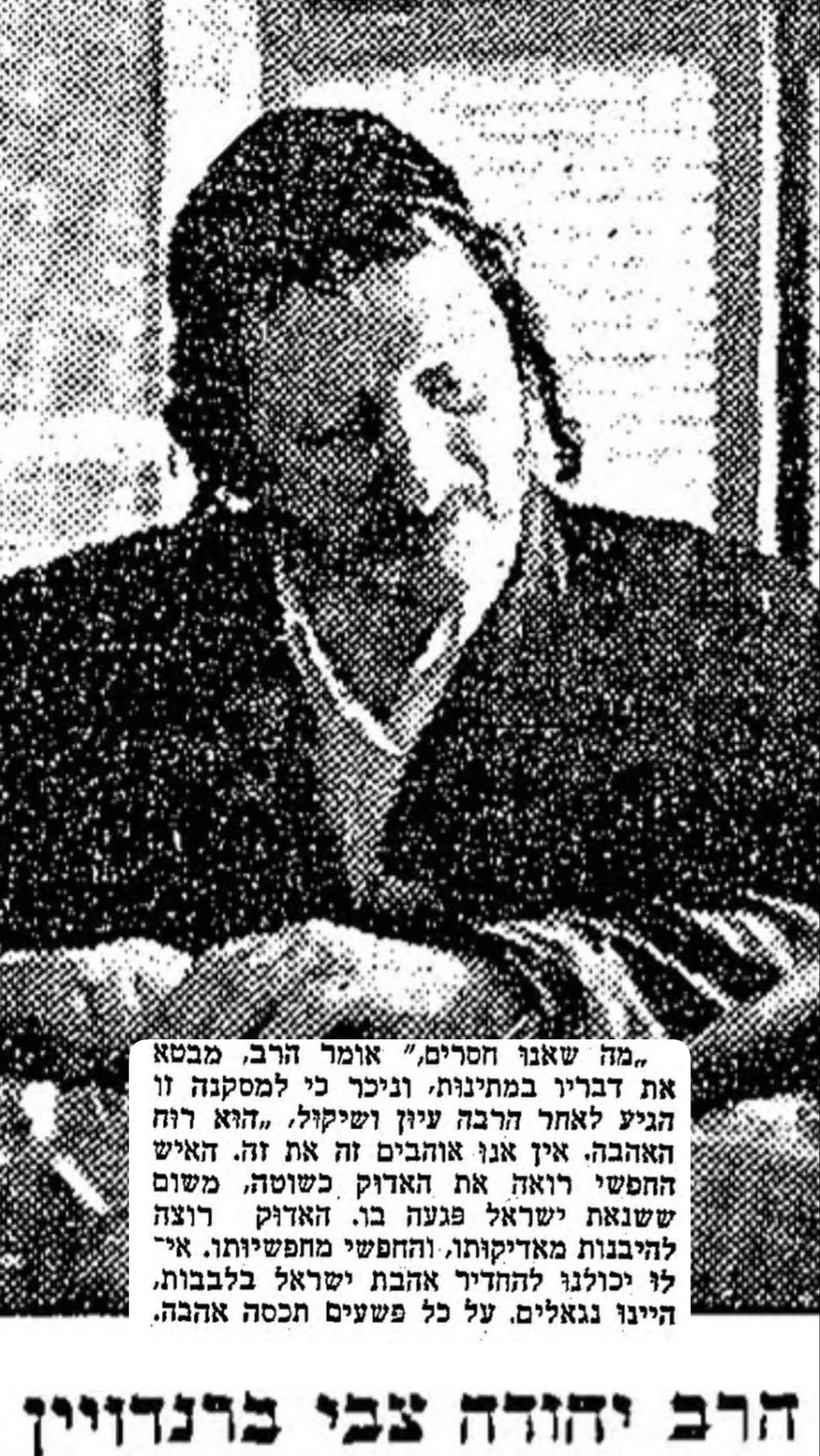
Caption from the press photograph
“What we lack,” says the rabbi, speaking deliberately; it is clear that he has reached this conclusion after much study and reflection, “is the spirit of love. We do not love one another. The secular man regards the devout man as a fool because hatred of his fellow Jew has taken hold of him. The devout man seeks to build himself up through his piety, and the secular man through his freedom from religious observance. If we could instil love for our fellow Jews in people’s hearts, we would be redeemed. Love covers all transgressions.”
Show Hebrew transcript
„מה שאנו חסרים,” אומר הרב, מבטא את דבריו במתינות, וניכר כי למסקנה זו הגיע לאחר הרבה עיון ושיקול, „הוא רוח האהבה. אין אנו אוהבים זה את זה. האיש החפשי רואה את האדוק כשוטה, משום ששנאת ישראל פגעה בו. האדוק רוצה להיבנות מאדִיקותו, והחפשי מחפשיותו. אילו יכולנו להחדיר אהבת ישראל בלבבות, היינו נגאלים. על כל פשעים תכסה אהבה.”